

A Dialogue in New York on Global Migration That Remains Out of Touch with Reality | FEMI 2026
May 20, 2025
By: Natalia Betancourt, Harrison Hanvey, and Sarah Lockhart
New York is a city often associated with movies, music, and iconic images. But today, it is worth speaking about for another reason: every four years, it becomes a global gathering place for political dialogue on migration through the International Migration Review Forum (IMRF). From May 4–8, representatives of governments, civil society, UN agencies, universities, and other stakeholders gathered at United Nations headquarters to assess progress on the Global Compact for Safe, Orderly and Regular Migration.
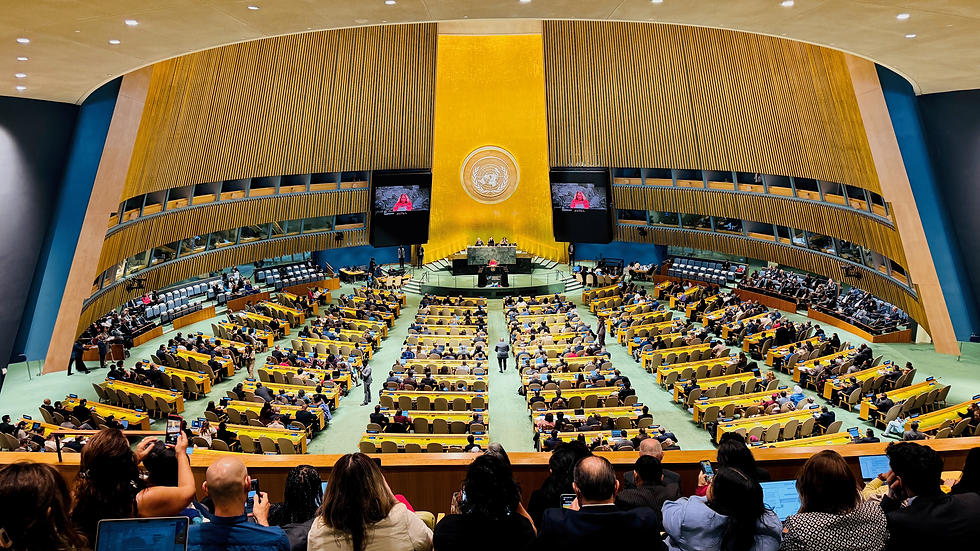
The Jesuit Migrant Network (RJM) has long raised concerns about the Global Compact because it is rooted in the assumption that migrants’ rights can be protected so long as migration happens through “regular” channels. Yet, as RJM has repeatedly emphasized, people forced to migrate often face realities far more complex than the framework assumes. In most cases, they are unable to meet the requirements States impose for regular entry—such as valid passports, visas, or background documentation. At the same time, RJM continues to affirm a fundamental principle: migration is a human right, and States have an obligation to protect it.
Throughout the forum, civil society groups worked to advance a range of shared messages. Organizations from Latin America and the Caribbean, in particular, called for greater consistency between States’ rhetoric and their actions. They urged governments not to roll back hard-won progress, to ensure meaningful participation by migrants themselves, to guarantee rights regardless of migration status, and to promote migration governance grounded in human rights. Participants also repeatedly denounced the growing criminalization of migration, including immigration detention, family separation, arbitrary revocations of legal statuses, and deportation policies that continue to take precedence over the protection of life and human dignity across the continent.
RJM also participated in coordinated advocacy efforts among Catholic organizations. Together with Red Clamor, Scalabrinians Foundation, Franciscans International, VIVAT International, Caritas Internationalis, and Caritas Latin America, RJM in the Americas organized the side event Walking with Messengers of Hope: Faith Communities Respond to the Reconfiguration of Migration in the Americas. The event reaffirmed that migration governance must be centered on human dignity and that States cannot retreat from their international obligations toward migrants.
Academic institutions also played an important role in the forum by grounding discussions in data and evidence related to States’ human rights obligations under the Global Compact. In that context, particular value was placed on proposals urging countries not to replicate increasingly restrictive migration policies promoted by the United States, but instead to continue strengthening protection frameworks developed in recent years.
Among States, countries such as Colombia, Brazil, Guatemala, Uruguay, and Spain stood out for advocating a human rights–based approach to migration governance, including more flexible regularization pathways, cooperation centered on human dignity, and stronger collaboration with civil society, churches, and academia. Mexico additionally emphasized the need for greater complementarity between the Global Compact for Migration and the Global Compact on Refugees.
At the same time, troubling trends were also evident. One of the Compact’s stated goals—international cooperation—is increasingly being used to expand and grow externalization policies, the criminalization of migrants and those who accompany them, and the growing militarization of migration governance. These concerns were echoed by the UN Special Rapporteur on the Human Rights of Migrants during one of the IMRF working sessions.
Concerns also grew around renewed commitments by countries such as Sweden, Finland, the Netherlands, and Denmark to expand “voluntary return” programs coordinated by the International Organization for Migration (IOM). Civil society organizations have repeatedly documented how the language of “voluntary return” often obscures the coercive conditions surrounding deportation, undermining principles such as non-refoulement and due process. Shortly after the forum concluded, on May 15, members of the European Council also agreed to a declaration that could increase the risk of mass deportations across Europe.
Canada, meanwhile, emphasized the importance of “safe migration” and argued that public confidence in migrants is necessary for migrants to contribute fully to society. Yet despite Canada’s longstanding reputation as a regional leader on migration, recent years have seen the country adopt increasingly restrictive asylum and migration measures that leave many people more vulnerable and at greater risk of deportation.
Other governments continued to frame migration primarily through a security lens. Panama insisted that security should remain at the center of migration policy, while Chile reaffirmed State sovereignty in determining migration policy and introduced additional barriers through documentation requirements and digital application systems operated from abroad, without acknowledging the country’s broader international human rights obligations.
RJM’s participation in the IMRF is part of broader regional coordination efforts through the Latin American Migration Bloc and Articulación LAC, which bring together civil society organizations across the region. At the same time, significant barriers continue to limit meaningful civil society participation in spaces like these:
The requirement to obtain a visa in order to enter countries such as the United States.
Language barriers, since most of the main proceedings took place in English, with interpretation available only to a limited number of participants, while side events often lacked interpretation altogether.
The high costs of lodging, transportation, and food in a city like New York.
A growing climate of fear and criminalization directed toward civil society, particularly in the United States, where threats have been made to revoke visas from people who oppose current government policies.
As RJM in the Americas continues participating in these spaces, the network remains committed to amplifying the voices and stories of migrants, as well as the work of communities on the ground that continue to practice hospitality in the face of increasingly hostile migration policies. RJM also remains committed to international cooperation that welcomes, protects, promotes, and integrates people who have been forced to migrate, while continuing to work alongside all relevant actors toward that goal.
--------------------------------------------


Comentarios